Australian nurses have served their country in times of war since 1899. Their stories are extraordinary.
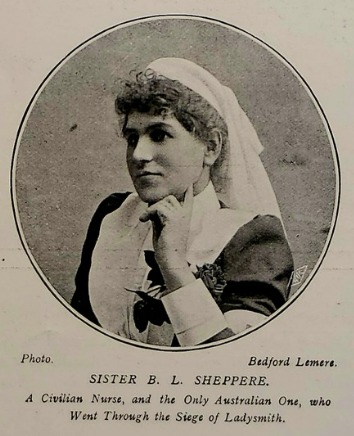
After arriving in South Africa in June 1899 in anticipation of the outbreak of war, and keen for an opportunity to serve, in late October 1899 Ballarat-born civilian nurse Rose Shappere arrived at Ladysmith just days before the town was besieged by the Boer forces of General Joubert. She nursed throughout the siege, which ended in February 1900, and subsequently joined Princess Christian’s Army Nursing Service Reserve. She is apparently the first Australian nurse to serve in the Second Boer War.
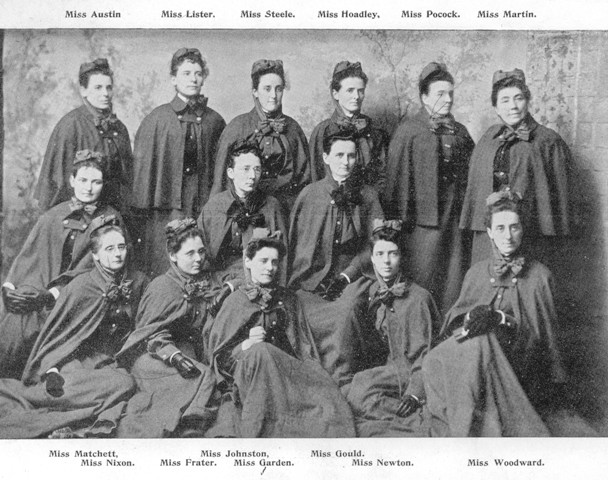
Altogether some 65 Australian nurses served in South Africa and Rhodesia between 1899 and 1902 – some, like Rose, having travelled independently, but most having arrived in state-based contingents. The first contingent, 14 nurses of the New South Wales Army Nursing Service Reserve, departed Sydney on 17 January 1900 aboard the SS Moravian.
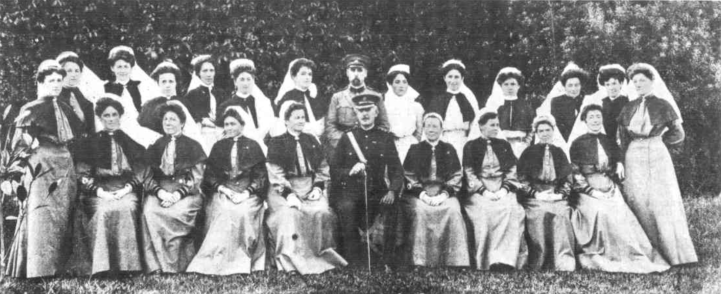
Following Federation in 1901, the Commonwealth set about amalgamating state-based military and militia units into a national defence body. As part of this effort, on 30 July 1902 General Order 123/1902 directed the restructuring of state-based army medical services into a single Australian Army Medical Corps. Paragraph 9 of the general order stated that: “An Army Nursing Service Reserve will be organized from those trained nurses who are qualified and willing to serve as such with stationary field hospitals and base hospitals when required upon a national emergency.” This is the foundational basis of the Australian Army Nursing Service (AANS). The order came into effect on 1 July 1903, and the AANS was formed with an establishment of one Lady Superintendent and one Matron in each state; 24 Nursing Sisters in New South Wales and Victoria; 14 in Queensland and South Australia; and 10 in Western Australia and Tasmania.
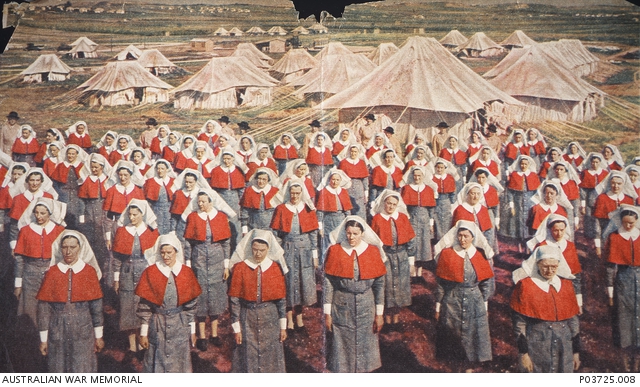
The nurses of the AANS were called upon for the first time during the Great War. According to newspaper reports at the time, by the end of the war, no fewer than 2,379 nurses had embarked from Australia, serving in Belgium, England, Egypt, France, Greece, India, Malta, New Britain, Salonika and on hospital ships and transports, while a further 588 nurses were enrolled for home service.
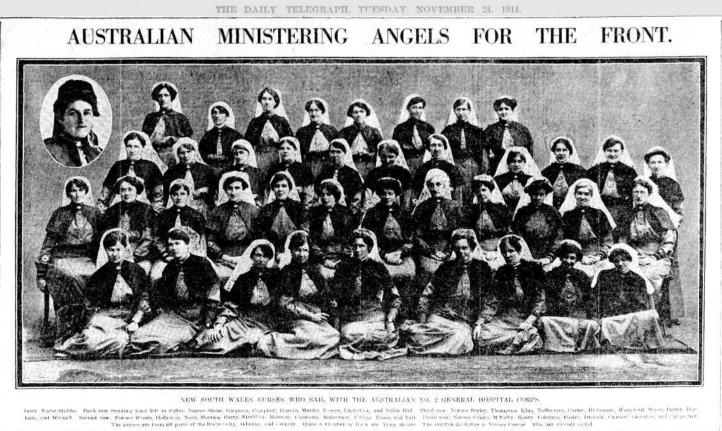
During the Second World War, as many as 4,000 nurses of the AANS, RAAF Nursing Service and RAN Nursing Service served in England, Greece, Crete, Egypt, Libya, Eritrea, Palestine, Syria, Ceylon, Malaya, Netherlands East Indies, New Guinea, New Britain and Solomon Islands, on hospital ships and transports, and throughout Australia.
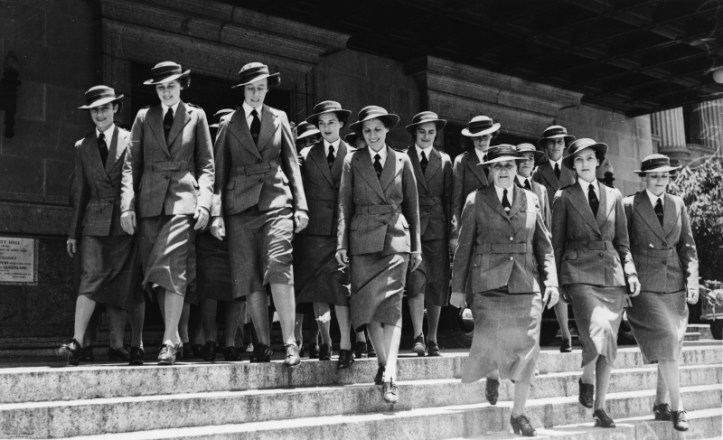
From 1942 to 1945 RAAFNS nursing sisters served in New Guinea and the Netherlands East Indies.
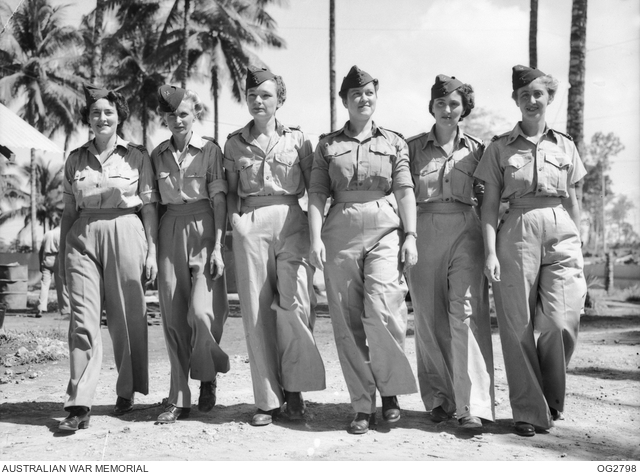
In 1946, nurses of the AANS and RAAFNS and members of the Australian Army Medical Women’s Service were posted to the 130th AGH on the island of Eta Jima, near Kure, Japan, as part of the British Commonwealth Occupation Force. In 1948 the AANS was granted the prefix ‘Royal’ in recognition of its service during the two world wars.
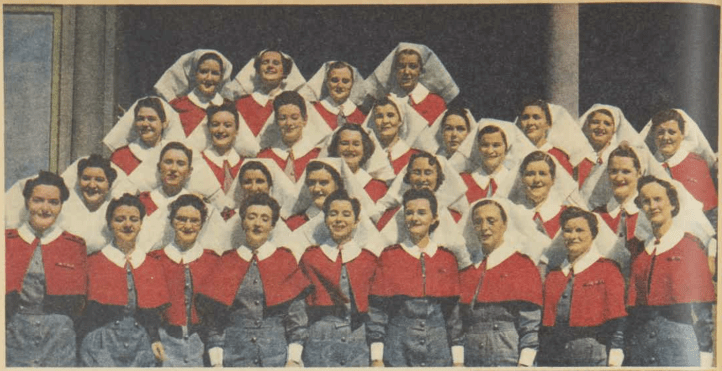
Australian nurses remained posted in Kure until 1956. In 1951 the RAANS had become the Royal Australian Army Nursing Corps (RAANC) and other ranks had joined RAANC officers on deployment.
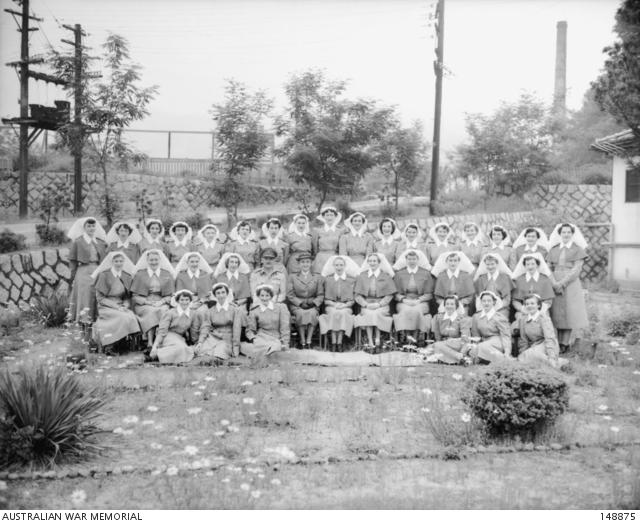
Between 1950 and 1956, 153 RAANS/RAANC and RAAFNS nurses served in Commonwealth hospital units in Japan and Korea during the Korean War and its aftermath.
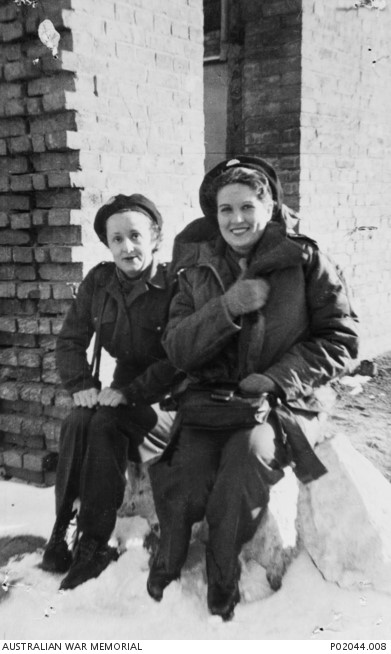
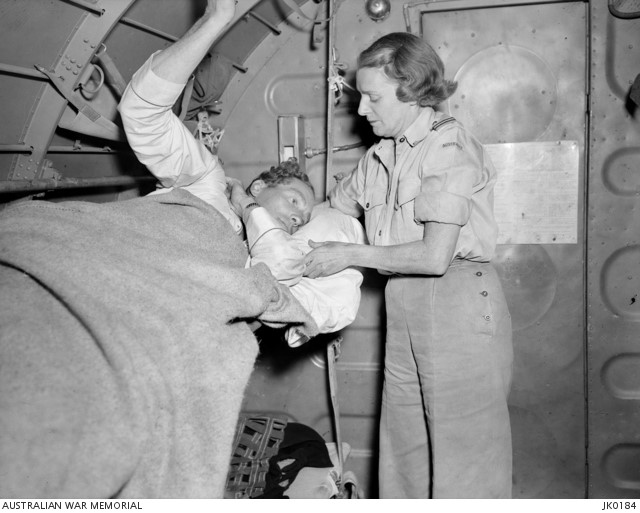
In September 1955, six RAANC nurses were deployed to Malaya during the Malayan Emergency (1948–1960). They worked at the British Military Hospital in Kamunting, at a convalescent hospital in the Cameron Highlands, and elsewhere.
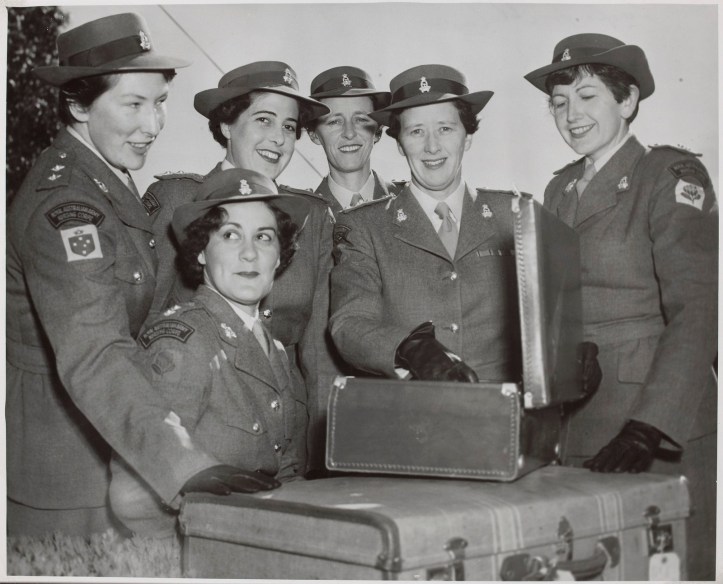
RAANC nursing officers remained in Malaysia (so named in September 1963) until at least October 1968.
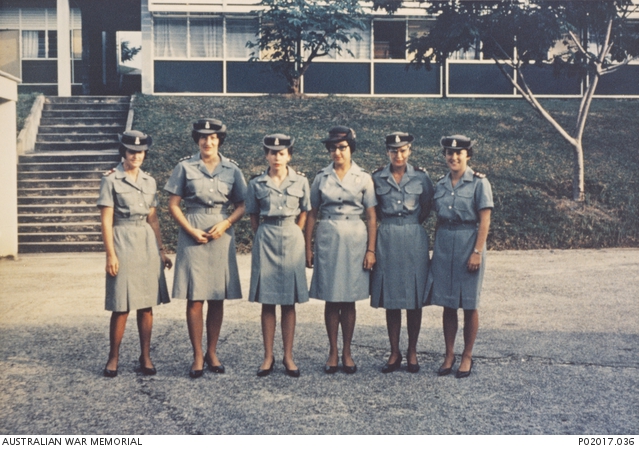
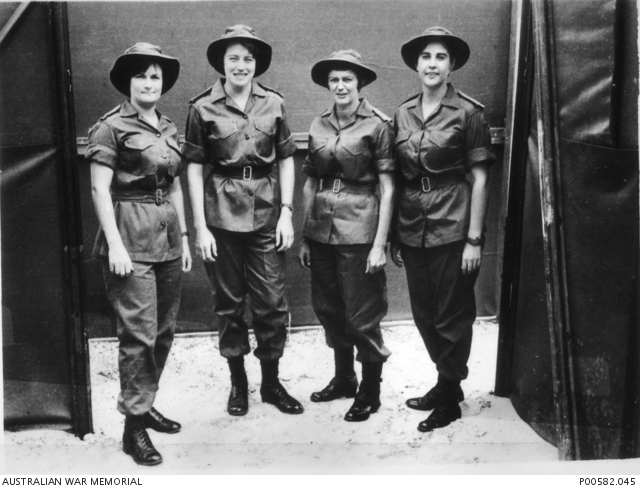
Between May 1967 and November 1971, 43 RAANC nursing officers served in Vietnam.
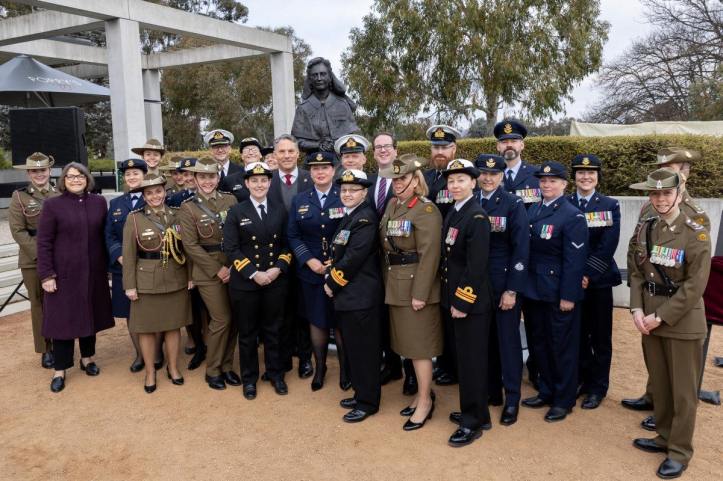
Since 1990, Australian military nurses have supported Australian and multinational combat, peacekeeping and humanitarian operations in Afghanistan, Banda Aceh (Indonesia), Bougainville, Cambodia, East Timor, Fiji, Iraq, Kurdistan, Pakistan, Papua New Guinea, the Persian Gulf, Rwanda, Somalia, Solomon Islands, Ukraine and elsewhere.
SOURCES
- The Advertiser (Adelaide, 2 Aug 1902, p. 7), ‘Army Medical Corps.’
- Annual Report upon the Military Forces of the Commonwealth of Australia (Parliament of Australia, No. 37, 1 May 1903).
- The Argus (Melbourne, 24 Jul 1919, p. 4), ‘Army Nursing Service.’
- Australian Army Journal (No.57, Feb 1954, pp. 37–42), ‘The Royal Australian Army Nursing Corps.’
- Australian War Memorial, ‘Australian nurses in the Korean War,’ 15 Jul 2020.
- Australian War Memorial, ‘Historical records of RAAF Nursing Service,’ AWM137.
- The Australian Women’s Register, ‘Royal Australian Army Nursing Corps (RAANC).’
- The Australian Women’s Register, ‘Australian Army Medical Women’s Service (AAMWS).’
- Bassett, J. (1992), Guns and Brooches: Australian Army Nursing from the Boer War to the Gulf War, Oxford University Press.
- Biedermann, N., Advances in Historical Studies (Vol.6, No.2, Jun 2017, pp. 65–77), ‘Australian Military Nursing from ANZAC to Now: Embracing the Ghosts of Our Nursing Ancestors.’
- Casey, L. (2011), ‘Welcome the wounded: Australian service nurses in recent theatres of conflict,’ Australian War Memorial.
- Commonwealth of Australia Gazette (21 Nov 1903 [Issue No.65], p. 865), ‘Commonwealth Military Forces.’
- The Courier-Mail (Brisbane, 30 Oct 1942, p. 4), ‘New Army Nurse Grade.’
- DVA (Department of Veterans’ Affairs) (2025), ‘Army nursing in Australia since 1899,’ DVA Anzac Portal.
- McLeod M. and Francis K., International Journal of Nursing Practice (2007; 13: 341–347), ‘Invisible partners: The Royal Australian Army Nursing Corps pathway to the Malayan Emergency.’
- New South Wales Government Gazette (Sydney, 30 Aug 1898 [Issue No.762 (Supplement)], p. 6955).
- RAAF News (1 Dec 1990, p. 7), ‘50 Years of Caring.’
- Royal Navy Research Archive, ‘RAAF Station Iwakuni.’
- Sydney Morning Herald (9 Feb 1942, p. 4), ‘New Ranks for Army Nurses.’
- Weekly Times (Melbourne, 21 Oct 1942, p. 18), ‘First Nurses for Australian Navy.’
 australianwarnurses.org